By K-Labs Custom Rods NZ
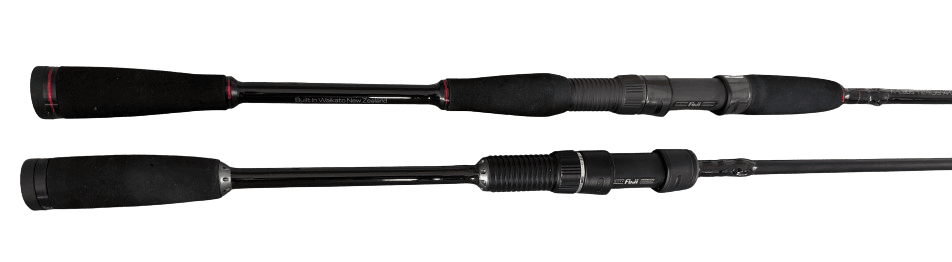
Introduction
Most anglers never think about it.
Most factory rods don’t get it right.
But reel seat placement is one of the most important decisions in rod building — and one of the biggest reasons custom rods feel so much better than mass-produced rods.
Move the reel seat forward, and the rod feels longer, slower, and less responsive.
Move it back, and it becomes faster, more sensitive, and noticeably more powerful in your hands.
A rod is a lever.
The fulcrum point — where the rod naturally pivots — determines everything about how a rod loads, casts, and fights fish.
Understanding this single principle can completely change how your rod performs.
1. The Rod’s Fulcrum Point Explained
Every rod has a natural pivot or fulcrum point — the exact place where:
- your hand pressure
- the reel weight
- rod flex
- and the blank’s load
all meet.
Move the reel seat and you physically shift that fulcrum.
Shift the fulcrum, and the entire rod behaves differently.
A rod is simply a lever, and reel seat placement determines how long each arm of that lever is — in front of your hand, and behind it.
That distance controls:
- speed
- leverage
- balance
- sensitivity
- casting feel
- fatigue
- hook-set power
Everything.
2. Why Factory Rods Get Reel Seat Placement Wrong
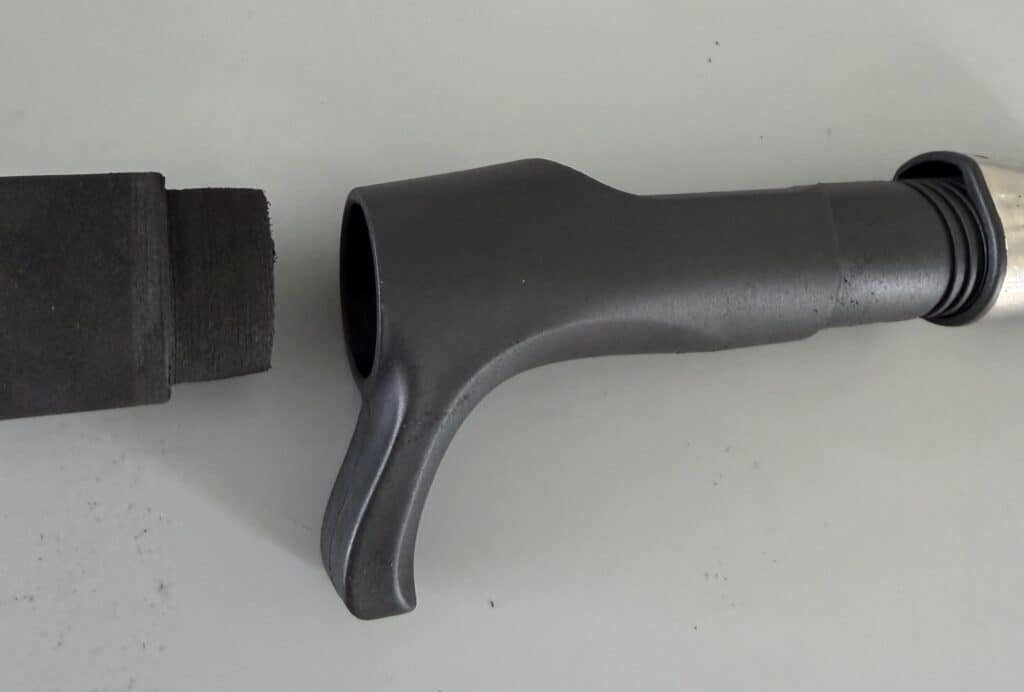
Most factory rods place reel seats too far forward.
There are two reasons:
A) It’s faster for mass production
Factories use preset jigs for handle assembly.
That means:
- fixed rear grip lengths
- fixed foregrip lengths
- fixed reel-seat positions
- zero adjustment
- maximum speed
Mass production demands uniformity, not optimisation.
Adjusting reel seat placement adds labour time — so they don’t do it.
B) They design rods to fit the “average” angler
Factories don’t know:
- your arm length
- your natural hand spacing
- your fishing style
- where you grip the rod
- your preferred balance
So they build around a generic middle ground.
The result:
❌ less leverage
❌ reduced sensitivity
❌ inefficient fulcrum mechanics
❌ awkward casting feel
❌ increased fatigue
This is why many factory rods feel dull or unbalanced — the handle layout is built for convenience, not performance.
⭐
Reel Seat Placement Trends Around the World
Reel seat placement is also shaped heavily by regional fishing styles.
🇺🇸
United States — 8–10” Butts Are Standard on Bass Rods
US bass rods commonly have 8–10 inch rear grips.
Not because it’s optimal for power — but because bass fishing is:
- tip-down
- close-range
- wrist-driven
- based on one-hand lure control
These short grips became industry standard simply because they fit the technique.
🇦🇺
Australia — Same Trend on Bass & Barra Rods
Australian bass & barra rods also use 8–10 inch butts, again because:
- one-handed lure work
- tip-down rod angle
- shallow-water presentations
These designs work for that specific style — but they aren’t optimal for leverage or fulcrum mechanics.
Different Regions → Different Defaults
Compare this with:
- NZ softbaiting
- surfcasting
- rock fishing
- offshore jigging
- slow pitch
- livebaiting
These use much longer handles with completely different fulcrum positions.
Why this matters
This proves most handle layouts are based on:
- tradition
- production templates
- regional norms
NOT on what actually produces the best balance, power, or sensitivity.
This is where custom rods outperform factory rods every single time.
3. The Downside of Forward Reel Seat Placement
Setting the reel seat too far forward causes:
❌ Reduced leverage and lifting power
❌ Less sensitivity
❌ Slower rod recovery
❌ Tip-heavy feel
❌ More fatigue during lure work
❌ Less accuracy and control
It makes even a premium blank feel average.
⭐
Small Changes Make a Huge Difference
This is something most anglers never realise:
Even moving a reel seat by just 10–20 mm can completely change how a rod loads, balances, and feels.
A tiny shift can turn a rod from sluggish → sharp, or from tip-heavy → perfectly balanced.
This is exactly why custom rods feel so good — the smallest details are tuned precisely for the angler.
4. Move the Reel Seat Back — What Happens
A well-placed reel seat transforms the rod:
✔
More leverage
Less effort, more lifting power.
✔
Better sensitivity
Shorter vibration travel path = clearer feel.
✔
Sharper action
A quicker, more responsive blank.
✔
Better balance
The fulcrum lines up with your natural grip.
✔
More precise lure control
Softbaits, jigs, and micro lures feel “connected.”
These improvements are instantly noticeable.
5. Your Arm Length Actually Matters
Custom rods account for:
- reach
- hand spacing
- reel weight
- fighting style
Factory rods don’t.
This alone makes a huge difference in comfort and performance.
6. How Reel Seat Placement Changes Action
Reel seat placement directly affects:
Rod stiffness distribution
Forward seat = stiffer butt, deeper loading
Rear seat = faster action, more tip speed
Hook-set power
Closer to the blank = more direct energy transfer
Casting feel
Forward = slower, heavier load
Rear = sharper, quicker snap
The rod’s entire character changes.
7. Sensitivity Improvements
A shorter reel seat distance increases:
- blank-to-hand connection
- vibration clarity
- bite detection
- lure feedback
- overall responsiveness
This is why people often describe custom rods as:
“Way more alive than my factory rods.”
8. Fighting Power & Leverage Mechanics
Forward reel seat:
- harder to lift
- soft in the butt
- more tiring
Optimised reel seat:
- easier lifting
- stronger butt power
- less fatigue
- better control under load
Especially noticeable for:
- softbaiting
- slow pitch jigging
- straylining
- snapper spinning
- kayak fishing
9. Why Factory Rods Rarely Get It Right
Because factories prioritise:
- speed
- cost
- templates
- uniformity
Custom rods prioritise:
- the angler
- the technique
- the blank’s behaviour
- perfect fulcrum tuning
That’s the difference.
Conclusion
Reel seat placement is not cosmetic — it is a core performance factor.
It affects:
- action
- leverage
- sensitivity
- balance
- comfort
- fatigue
- casting
- power
Small changes make big differences, and the right layout makes a rod feel like a true extension of your arm.
This is why custom built rods consistently outperform mass-produced rods — they’re built around you.
FAQ — Reel Seat Placement & The Fulcrum Point
1. What is the fulcrum point on a fishing rod?
The fulcrum point is the natural pivot point created where your hand pressure, reel weight, and the rod’s flex all meet. Changing reel seat placement shifts this pivot, which changes how the rod loads and behaves.
2. How does reel seat placement affect rod performance?
It changes leverage, balance, power delivery, sensitivity, casting comfort, and how efficiently the rod transfers energy. A small shift in placement can noticeably change how a rod feels and performs.
3. Why does moving the reel seat a few millimetres make such a difference?
Because it alters the length of the lever arms in front of and behind your hand. Even tiny changes shift the balance point and pivot point, affecting loading, tip control, and fatigue.
4. How does reel seat position affect rod sensitivity?
Incorrect positioning can dampen vibrations or create an unbalanced feel. A well-placed reel seat improves vibration transfer, making bites easier to feel — especially with light lures.
5. Does reel seat placement affect casting distance?
Yes. Poor placement changes how efficiently the rod loads and unloads during the cast. Optimal placement improves load timing, increases energy transfer, and reduces wasted movement.
6. Should reel seats be placed differently for soft-baiting vs. jigging?
Yes. Soft-bait rods need slightly different leverage and balance than mechanical jig rods. NZ anglers often prefer a more forward or rear-biased setup depending on technique and lure weight.
7. Does reel weight matter when choosing reel seat placement?
Absolutely. Reel weight significantly affects balance and the fulcrum point. A heavy reel moves the balance point rearward; a light reel pushes it forward.