What is progressive guide spacing?
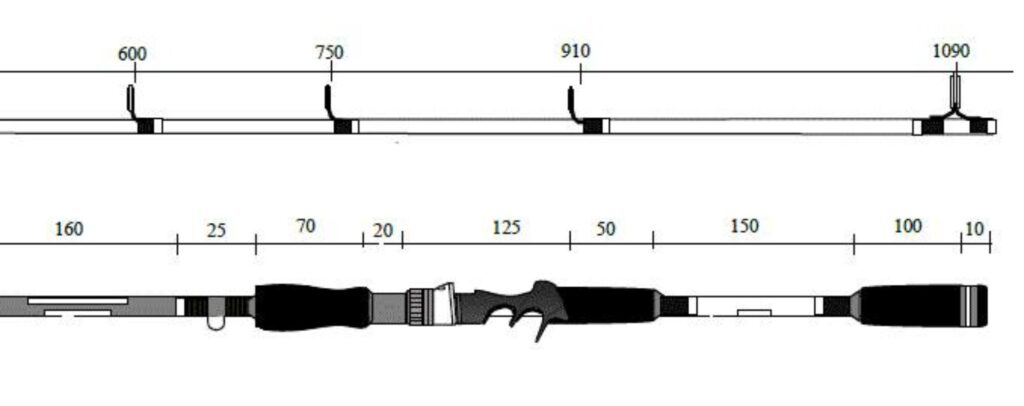
Progressive guide spacing is the method of placing rod guides at non-equal distances, gradually changing spacing from the butt section to the tip of the rod.
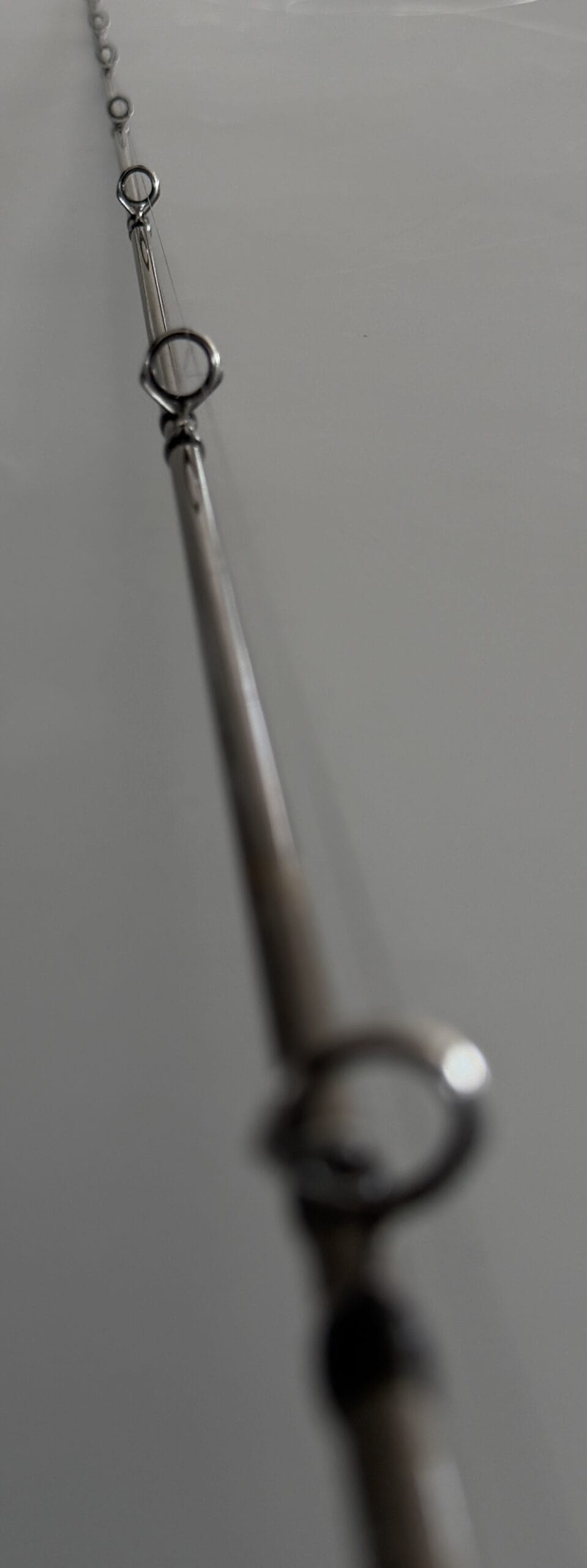
Unlike basic equal spacing, progressive spacing follows how a rod actually bends and loads under pressure, rather than relying on simple measurements.
This approach is standard in high-performance custom rod building and is critical for rods designed to cast efficiently, load smoothly, and protect both line and blank.
Why equal spacing doesn’t work well
Many factory rods — and even some custom builds — still use equal guide spacing because it’s fast and repeatable.
The problem is simple:
- Rod blanks do not flex evenly
- Stress concentrates in specific zones
- Line control suffers during the cast
- Load is poorly distributed when fighting fish
Equal spacing ignores how the blank behaves under real fishing loads.
How progressive guide spacing improves performance
When done correctly, progressive spacing delivers several measurable benefits:
🎯 Improved casting control
Progressive spacing keeps the line following the natural curve of the blank, reducing line slap and improving energy transfer during the cast.
🐟 Better load distribution
Stress is shared across more of the blank instead of being concentrated at a few points, improving both power delivery and durability.
🧵 Reduced line wear
Proper spacing maintains consistent line angles through the guides, minimising friction and unnecessary abrasion.
🪶 Enhanced sensitivity
With the blank working as intended, subtle vibrations transmit more cleanly through the rod — especially important for jigging, softbaiting and finesse techniques.
Progressive spacing vs static load testing
Progressive guide spacing is often combined with static load testing, not replaced by it.
At K-Labs, progressive spacing provides the baseline layout, which is then refined under load to ensure:
- Even stress curves
- Clean line path
- No dead spots
- No over-worked guide zones
This combination produces a rod that performs consistently across casting, retrieving, and fighting fish.
Is progressive spacing the same for every rod?
No — and that’s the point.
Progressive spacing varies depending on:
- Rod length
- Blank taper and material
- Guide size and frame style
- Reel type (spin, overhead, acid wrap)
- Intended fishing application
A surf rod, slow-pitch jig rod, and softbait rod all require different spacing logic — even if they share similar lengths.
Why this matters on custom fishing rods
Custom rods exist to solve problems factory rods can’t.
Progressive guide spacing is one of those solutions — subtle, often unseen, but critical to how a rod performs over its lifetime.
It’s not about adding more guides or copying a formula.
It’s about matching the guide layout to the blank and the way the rod is actually used.
The K-Labs approach
At K-Labs, progressive guide spacing isn’t a buzzword — it’s part of our build standard.
Every rod is laid out with:
- Blank-specific spacing
- Application-driven logic
- Real-world loading in mind
The result is a rod that casts cleaner, fights smoother, and lasts longer — without unnecessary weight or compromise.
Final thoughts
Progressive guide spacing is one of the most important — and most misunderstood — elements of rod performance.
You may never see it on a spec sheet, but you’ll feel it every time the rod loads, casts, and comes alive under pressure.
That’s the difference thoughtful design makes.
Frequently Asked Questions
What is progressive guide spacing?
Progressive guide spacing is a layout method where the distance between rod guides increases gradually from the tip toward the butt. This allows the rod blank to flex naturally under load while maintaining smooth line control.
Is progressive guide spacing better than equal spacing?
Yes. Equal spacing ignores how a blank actually bends. Progressive spacing improves load distribution, reduces stress points, and results in better casting efficiency and fish-fighting control.
Does progressive guide spacing affect casting distance?
It can. By controlling the line path more efficiently and reducing unnecessary line slap, progressive spacing often improves casting smoothness and consistency — particularly with braid.
Is progressive guide spacing used on surf rods?
Absolutely. Long surf rods benefit significantly from progressive spacing due to their length and wide casting arc. It helps maintain line control during high-energy casts.
Do spinning rods and baitcasting rods use the same spacing?
No. While the principle of progressive spacing remains the same, spinning rods, conventional rods, and acid-wrapped rods all require different guide counts, sizes, and placement strategies.
How many guides should a rod have?
There is no fixed rule. Guide count depends on rod length, blank action, line type, and intended use. Progressive spacing focuses on performance, not arbitrary guide numbers.
Is progressive guide spacing suitable for acid-wrapped rods?
Yes. In fact, progressive spacing works exceptionally well with acid wraps, as it helps manage the transition of load from the top to the underside of the blank smoothly.
Can I use progressive guide spacing on heavy rods?
Yes. Heavy jig, live-bait, and game rods often benefit from progressive spacing to better distribute load and reduce localized blank stress under high drag pressures.
Is guide spacing the same for every blank?
No. Every blank bends differently. Progressive spacing should always be adjusted based on blank length, power, action, and real-world deflection testing.
Do factory rods use progressive guide spacing?
Some do — many don’t. Factory layouts often prioritise production efficiency. Custom rod builds allow progressive spacing to be tuned specifically for performance.